As one does during Christmas sales season, I bought a couple of things for myself with the intention of using them—I’m talking, of course, about books. I can proudly say I’m one of those people who buys books when there’s a stack of unread ones on my nightstand. There’s no better way to be.
I finally dusted off one of them, though—and I’m very glad I did. East of Eden is a book that has stayed with me since I finished it, and I think it’s even helped change my perspective on things going on IRL. That is the sign of not just a good, but a GREAT book.
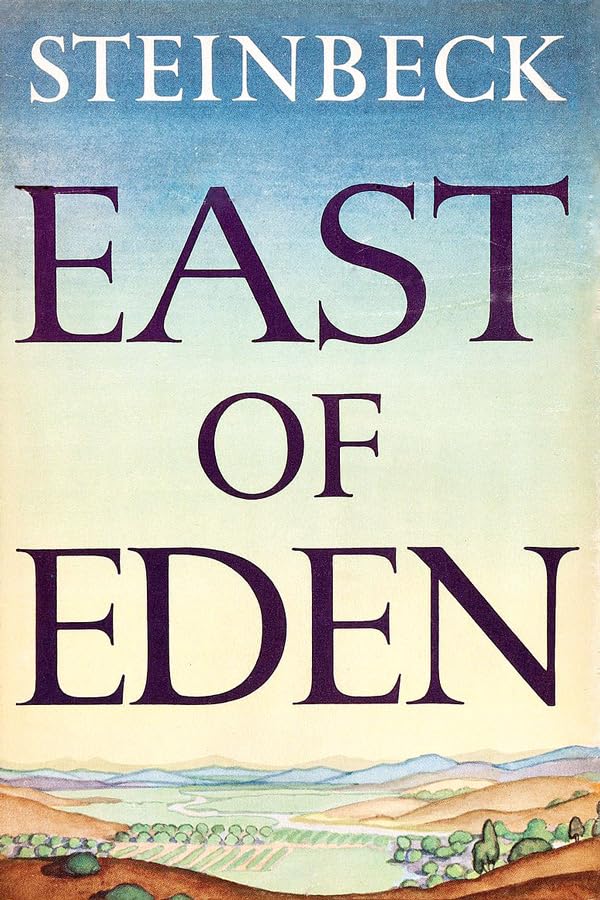
A one-paragraph synopsis: We follow the family stories of the Hamiltons and the Trasks, both of which settle int he Salinas Valley of California. The two stories are separate to start, then collide when Adam Trask enlists Samuel Hamilton to help dig wells on his property. Form there, the story really shifts in focus to Adam’s two kids, and their Cain and Abel-type arc.
I wish I could be more “deep” and point to an obscure scene or character and say “That’s my favorite!” But I’m a simple man: Samuel and Lee touched my soul a bit in the chapters they appeared in. In fact, I’d put Samuel up there as one of the best characters I’ve ever had the pleasure of meeting in a book.
But what really hooked me in deep is Steinbeck’s beautiful writing around the scenery. I am a sucker for writers that will take a page or two to describe how a scene looks, only to gloss through what we’re supposed to be getting out of it in a few paragraphs after. To start the book with a description of the Salinas Valley was a perfect way for Steinbeck to reel me in.
I find the narration of the book interesting, and what adds to the myth of everything that’s happening. Described as the son of Olive, and therefore a grandson of Samuel Hamilton, the narrator seems like he’s going to prod along and insert himself into the story—only to never actually do that. I take it to mean that John Steinbeck himself is the narrator of the story, but I suppose that is up for interpretation. How reliable is the narrator? I found it interesting that the narrator says right at the start of chapter 2 that he has to depend on “hearsay, on old photographs, on stories told, and on memories which are hazy and mixed with fable in trying to tell you about the Hamiltons.”
Indeed, sometimes the story of the Hamiltons does seem, well, biblical. Learning about Sam and Liza, and then their settling in Salinas—”I don’t know whether it was a divine stupidity or a great faith that let them do it,” our narrator says—and establishing their way of life. Then we eventually get introduced to the Trasks, then eventually to Cathy.
The buildup was slow, not going to lie. I appreciated the building up of the world around when the eventual story would take place, but I did have to force myself to get there. Then, when it finally clicked, it clicked. The scene that finally brought me all the way in was the naming scene/chapters. Samuel, Lee, and Adam, all coming together to name Adam’s kids. Samuel’s dialog throughout the chapter is worth digging into, and the back-and-forth with Adam over the punch to the face is something I could picture a kind man doing after punching a friend. But then they get to the naming part, and from there the story took over. Cal and Aron becoming “adults” was needed to get the story to its end, but the naming of them wasn’t something I expected to stick with me so much.
Then, of course, there’s the chapter. When the naming of the kids comes full circle, and as we learn more about Lee than we expected. I want to just spill out more but the risk of being a spoiler here is too great. It’s just a great bit of literature. There is one quote I will share here. Long story short: Ever thought something came into your life at a time when you needed it, but didn’t realize? I think maybe the decision to pick up East of Eden falls in that category. Sam—OK I’m going to say it, is he supposed to be a version of Moses? That was the vibe I got. There’s enough reference to religion in here—delivers the quote:
“Do you take pride in your hurt?” Samuel asked. “Does it make you seem large and tragic?”
East of Eden, page 417 of my Kindle edition
“I don’t know.”
“Well, think about it. Maybe you’re playing a part on a great stage with only yourself as an audience.”
That quote resonated with me. Sometimes, the pity parties we throw ourselves only have one attendee.
I think another interesting part about this chapter, the one in its most basic sense you’d describe as Samuel leaving the farm, is that the idea introduced in the discussion between Samuel, Lee, and Adam about the Book of Genesis is then put on display over and over again. Steinbeck is, in essence, beating us over the head with Lee’s message from that moment. So many characters, all in their own scenarios, all faced with a choice.
Of course, Cal and Aron’s story takes center stage now, and the clear references to Cain and Abel are obvious. I still enjoyed the shit out of it. And I liked how Steinbeck went about tackling Cal’s story.
The conclusion was abrupt, but death will do that. I loved how the final message was delivered, though, and how Steinbeck’s clever role of being the narrator/maybe not being the narrator also allows us to be roped into Adam’s final words.
I would easily throw this into my top 5 favorite books ever read. In terms of staying power, only Blood Meridian and The Passenger/Stella Maris have stuck with me for as long. Steinbeck’s magnum opus is long and maybe not the best entry point to his writing world, but I’m glad I conquered it. And I can’t wait to read it again.
Review: 9/10. It is very long.
Choice quotes
“They landed with no money, no equipment, no tools, no credit, and particularly with no knowledge of the new country and no technique for using it. I don’t know whether it was a divine stupidity or a great faith that let them do it.”
“Eventlessness has no posts to drape duration on. From nothing to nothing is no time at all.”
“Samuel stood in the doorway of the forge and looked at the land. ‘They say a mother loves best an ugly child,’ he said, and he shook his head sharply. ‘Tom, I’ll trade you honor for honor. You will please hold this in your dark secret place, nor tell any of your brothers and sisters—I know why I’m going—and, Tom, I know where I’m going, and I am content.”
“And here interpolated—it’s so hard to remember how you die or when. An eyebrow raised or a whisper—they may be it; or a night mottled with splashed light until powder-drive lead finds your secret and lets out the fluid in you.”
“It is one of the triumphs of the human that he can know a thing and still not believe it.”
“‘Maybe you’ll come to know that every man in every generation is refired. Does a craftsman, even in his old age, lose his hunger to make a perfect cup—thin, strong, translucent?’ He held his cup to the light. ‘All impurities burned out and ready for a glorious flux, and for that—more fire. And then either the slag heap or, perhaps what no one in the world ever quite gives up, perfection.’ He drained his cup and he said loudly, ‘Cal, listen to me. Can you think that whatever made us—would stop trying?'”


