As someone who’s typically not a huge fan of listening to podcasts, I listened to Andrew Huberman’s interview with psychologist Dr. Becky Kennedy in the middle of March and found myself glued to what I heard. Kennedy’s advice about raising kids stood out to me because instead of talking about timeouts or rewards and gold stickers, she talked about, what sounded to me at least, just kind of being real with your kid. As I see my parenting style grow and develop, something stuck with me about her basic, guiding principle, and the name of her book I subsequently picked up: Good Inside: A Guide to Becoming the Parent You Want to Be.
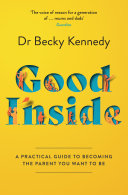
Originally published in September 2022, Kennedy’s book has launched her into quite a prominent spot in parent/child psychology, Styled as an introduction then two parts—one on her parenting principles, a second on real-life situations and ways to approach and think about them—the book flowed easily for me. Kennedy’s writing style is very approachable and understandable (some of her dialogue, however…) and the chapters on actionable steps are nice because they’re not overly complicated, and are easily accessible if you’re looking for reference later on.
But what I found most interesting about the book is that it spoke as much to me as a person, as it did to me as a parent. Kennedy’s approach of being “good inside” is about both our kids being fundamentally good, and therefore worthy of looking at in a light of compassion vs. frustration, but also you, the parent. Now perhaps that’s common knowledge to some, but reading through the first section of Kennedy’s book brought me to emotion on a few occasions simply because it felt nice to hear.
As stated, Kennedy’s framework for thinking about kids is apparent: They are good, their actions aren’t. It sounds odd, but that simple framework for thinking about my daughter immediately changed the way I thought about her actions. Remembering that the tantrum isn’t a result of her existing, but of an underlying emotion that’s worth exploring. I will say that part of me finds it exhausting how much Kennedy hammers this idea home, but I suppose it’s as much being new/resistant to the idea, as it is a bad thing.
I’m happy I read this book, and I would definitely suggest it to any parent that wants to try and approach the problems of their kids in a different way. If anything, just read the opening part where Kennedy lays out her framework and talks about how it can manifest itself in the rest of your life. The problem chapters aren’t exactly necessary reading in the moment—they’re more for when a particular issue arises.
Overall, I give it an 8/10. It’s good, not too long, contains valuable information, and Kennedy backs up everything she says with evidence and reasoning. Will it be the best way to raise a kid? Who knows. But each family is different, and if anything, Kennedy will have a valuable nugget or two you can stash away when raising your kid(s).
Memorable Quotes
A few quotes from the book I highlighted with my Kindle:
“Still, in those exhausting moments with your toddler when you wonder if all the hard work is worth it (because parenting a young child is really hard work!), take comfort in knowing that it absolutely is. The work you put in is always, always worth it.”
“And it’s also not too late for you. It’s not too late for you to consider what parts of yourself are in need of repair and reconnection; as adults, we can work on rewiring ourselves and changing the trajectory of our own development. It is not too late. It’s never ever ever too late.”
“So if our general goal is to support and not solve, or tolerate and not escape, then to build resilience in our kids, we should be guided by one question: am I helping my kid tolerate and work through this distress, or am I encouraging my child to avoid and beeline out of the distress? We want the first, not the second.”
“Showing our children that we feel the tough stuff, that we struggle with it and still get through, is truly the best lesson you can give them.”
“Feeling alone and desperate is incredibly difficult, given that humans feel safest when we have connection and hopefulness. This doesn’t mean you have to give in to your kids’ ridiculous demands, but the more you focus on those feelings underneath the surface and give them the connection they need, the less your children will whine.”

 A Whately Devil